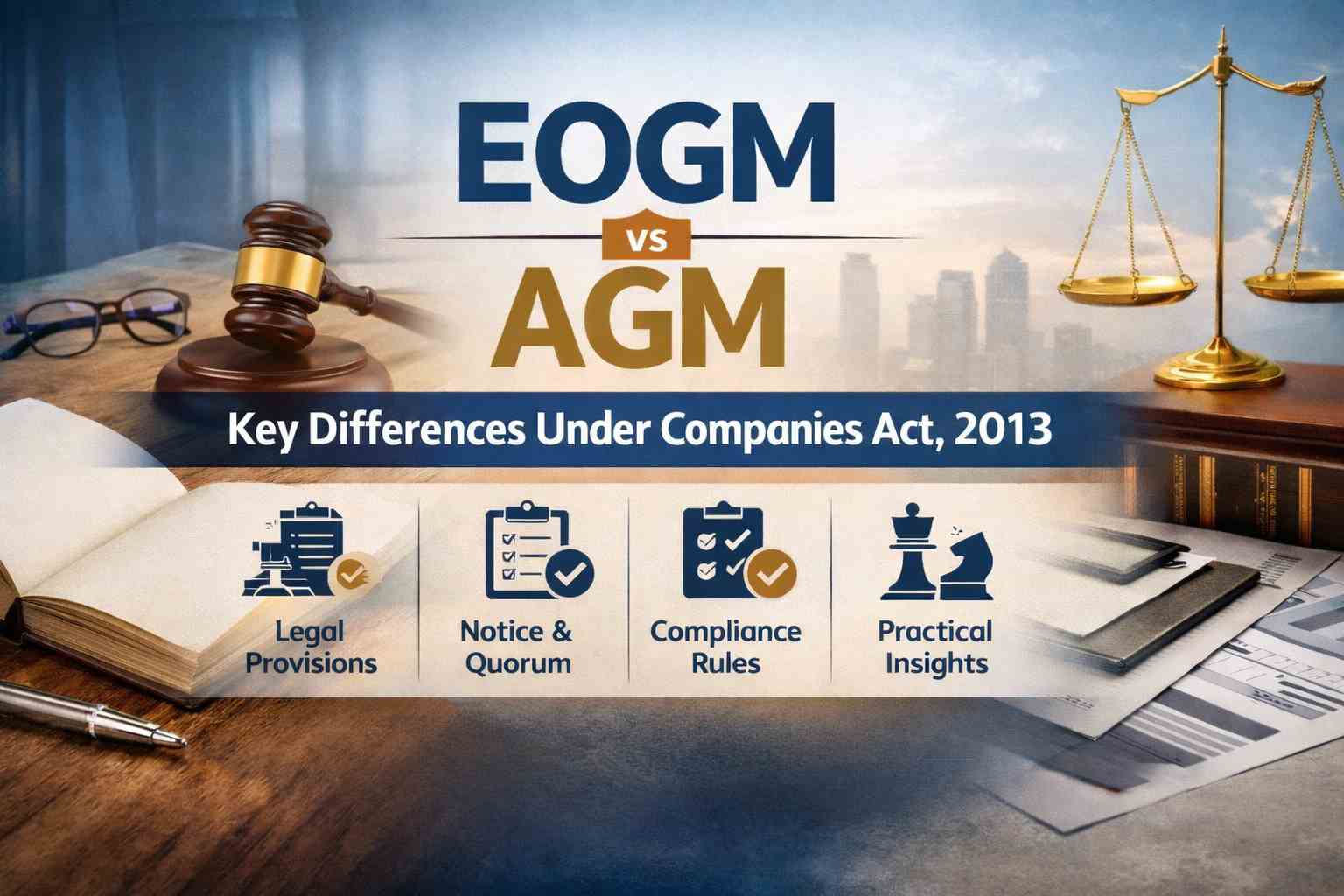
EOGM vs AGM: A Detailed Technical Analysis under the Companies Act, 2013
By Anand Acharya & Associates
Corporate governance in India is fundamentally driven by shareholder democracy, exercised primarily through general meetings. Among these, the Annual General Meeting (AGM) and the Extraordinary General Meeting (EOGM) are the two most critical forums for shareholder decision-making.
While often confused, these meetings differ significantly in statutory intent, procedural rigor, legal consequences, and strategic utility. This article provides a deep-dive, section-wise, and compliance-oriented comparison of AGM vs EOGM, with practical insights for companies and professionals.
1. Statutory Framework and Legislative Intent
1.1 AGM – Section 96 of the Companies Act, 2013
The AGM is a statutorily mandated annual compliance mechanism ensuring:
- Shareholder oversight over management
- Financial transparency
- Periodic accountability of the Board
It is not merely procedural, but a shareholder right, and failure to conduct AGM is treated as a serious compliance lapse.
1.2 EOGM – Section 100 of the Companies Act, 2013
EOGM is a contingent governance tool, designed to:
- Address urgent and non-routine matters
- Empower minority shareholders
- Override Board inaction (through requisition mechanism)
Unlike AGM, EOGM reflects situational corporate necessity rather than periodic obligation.
2. Frequency, Time Limits, and Gap Analysis
AGM – Strict Timelines
- First AGM: Within 9 months from end of first financial year
- Subsequent AGMs: Within 6 months from end of financial year
- Maximum gap: 15 months between two AGMs
Extension Provision
- Registrar of Companies (ROC) may grant extension (except first AGM)
- Extension cannot exceed 3 months
EOGM – No Prescribed Frequency
- Can be convened any number of times
- No statutory interval or upper limit
- Entirely driven by business exigencies
3. Authority to Convene Meeting (Power Dynamics)
AGM
- Solely convened by Board of Directors
- Shareholders cannot requisition AGM
EOGM – Multi-layered Authority Structure
(a) Board-initiated EOGM
- Called suo moto for urgent matters
(b) Requisitioned EOGM (Section 100(2))
Members holding:
- ≥10% of paid-up share capital (with voting rights) OR
- ≥10% voting power (in case of no share capital)
can requisition EOGM
Timeline Compliance:
- Board must call meeting within 21 days of valid requisition
- Meeting must be held within 45 days from date of requisition
Failure by Board:
- Requisitionists themselves may call meeting within 3 months
- Expenses reimbursable by company
(c) Tribunal-Ordered EOGM (Section 98)
- When it is impracticable to call meeting
- Tribunal may:
- Direct meeting
- Modify quorum requirements
4. Nature of Business: Ordinary vs Special
AGM
Ordinary Business (Section 102 Explanation)
- Adoption of financial statements
- Declaration of dividend
- Appointment/re-appointment of directors
- Appointment/re-appointment and fixing remuneration of auditors
Special Business
- Any other matter requiring shareholder approval
EOGM
- Only Special Business
- Every item requires Explanatory Statement under Section 102
5. Notice Requirements and Secretarial Standards
Statutory Notice (Section 101)
| Particulars | AGM | EOGM |
|---|---|---|
| Notice Period | 21 clear days | 21 clear days |
| Shorter Notice | Allowed with 95% consent | Allowed with 95% consent |
| Mode | Electronic + Physical | Same |
Secretarial Standard – SS-2 (ICSI) Compliance
Both AGM and EOGM must comply with:
- Proper agenda structuring
- Serial numbering of items
- Detailed notes to agenda
- Route map (mandatory for physical meetings)
- Attendance registers
- Scrutinizer appointment (for voting)
6. Explanatory Statement – A Critical Differentiator
Section 102 Compliance
AGM
- Required only for special business
EOGM
- Mandatory for all agenda items
Must Contain:
- Nature of concern/interest of:
- Directors
- Key Managerial Personnel (KMP)
- Relatives
- Financial implications
- Material facts
- Justification of resolution
Legal Risk:
- Inadequate disclosure → Resolution may be voidable
7. Quorum and Voting Mechanics
Quorum (Section 103)
| Company Type | Quorum |
|---|---|
| Private Company | 2 members |
| Public Company | 5 / 15 / 30 (based on members) |
Same applies to both AGM and EOGM unless modified by Tribunal.
Voting Methods
- Show of hands
- Poll
- E-voting (mandatory for listed & prescribed companies)
- Postal ballot (in certain cases)
8. Venue, Day, and Time Restrictions
AGM
- Must be held:
- During business hours (9 AM – 6 PM)
- On a non-national holiday
- At registered office or same city/town/village
EOGM
- No such restrictions
- Can be held:
- On any day (including holidays)
- At any place (subject to Articles & practicality)
9. Compliance Burden and Filings
AGM Related Filings
- AOC-4 (Financial Statements)
- MGT-7 (Annual Return)
EOGM Related Filings
- MGT-14 (for special resolutions)
- Event-based filings depending on resolution
10. Consequences of Non-Compliance
Failure to Hold AGM (Section 99)
- Company and every officer in default liable to:
- Penalty up to ₹1,00,000
- Continuing penalty ₹5,000 per day
EOGM Non-Compliance
- Invalid resolutions
- Shareholder disputes
- Oppression & mismanagement proceedings
- Regulatory scrutiny
11. Strategic and Practical Insights
AGM
- Planned governance tool
- Used for:
- Investor confidence building
- Financial disclosure
- Board accountability
EOGM
- Tactical governance instrument
- Used for:
- Fundraising (preferential allotment, rights issue)
- Structural changes
- Crisis management
12. AGM vs EOGM – Advanced Comparative Table
| Parameter | AGM | EOGM |
|---|---|---|
| Legal Nature | Mandatory statutory meeting | Contingent meeting |
| Trigger | Passage of financial year | Urgent business need |
| Initiation Control | Board-centric | Board + Shareholders + Tribunal |
| Business Scope | Ordinary + Special | Only Special |
| Flexibility | Low | High |
| Regulatory Scrutiny | High | Case-specific |
| Governance Role | Periodic accountability | Event-driven decision making |
Conclusion: Governance Perspective
AGM and EOGM are not interchangeable—they represent two distinct dimensions of corporate governance:
- AGM = Compliance + Accountability
- EOGM = Flexibility + Control Mechanism
A company that strategically utilizes both ensures:
- Strong governance framework
- Reduced litigation risk
- Enhanced shareholder trust
-CS Anand Acharya
Anand Acharya & Associates
Company Secretarites
Address: First Floor, Market near LIC building, C-15, Govind Nagar, Raipur, Chhattisgarh 492001
Phone: 091117 99837
Website: anandacharyaassociates.in
Have Questions? We're Here to Help
Get expert advice from Anand Acharya & Associates. Reach out to discuss your requirements.